
Helpline
×

Cholera Public Health Alert

Cholera Flyer

Blantyre City Council urges all residents to follow cholera prevention guidelines and report suspected cases immediately to the nearest health facility.

Download Flyer
Town Planning Banner

Town Planning Directorate

Background

The Directorate of Town Planning and Estates Services is responsible for the day-to-day urban planning and estate management functions of Blantyre City Council. It comprises three Sections namely, Town Planning, Estates, and Building Inspectorate. The three sections are headed by the Director of Town Planning and Estates Services. The Town Planning Section regulates forward planning and development control for orderly urban growth thereby ensuring sustainable urban land use. It provides various services including scrutiny of building plans, preparation of physical development plans, development control in the city, and management of planning projects. The Estates Section manages the City Council’s Estates, particularly low income areas. It is also responsible for the development of Estates, allocation of land to communities, valuation of properties, and upgrading of informal settlements. The Building Inspectorate Section promotes sustainable urban development by providing quality building and inspectorate services to clients.

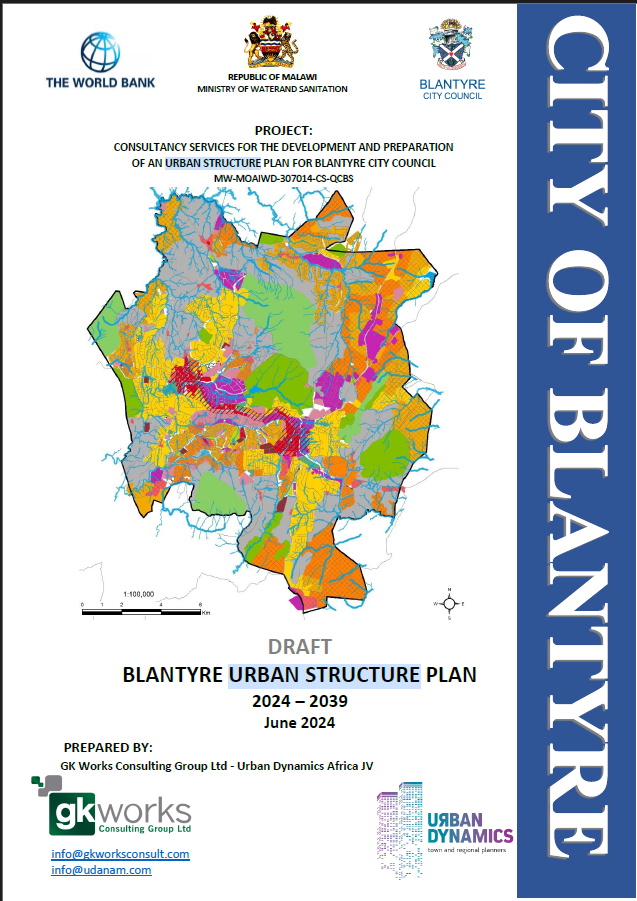
Blantyre Urban Structure Plan

The Blantyre Urban Structure Plan 2024 – 2039 was prepared in accordance with the requirements of the Physical Planning Act 2016 as amended in 2022 and includes a review of the existing conditions in Blantyre City. It sets a strategic framework for the development of the city, spells out planning policies and proposals, provides maps and plans to show present and future land and transportation uses and the location of proposed developments; and provides guidance on land uses for purposes of making decisions on applications for development permission. As Malawi’s second-largest city, Blantyre serves as a significant economic, administrative, and cultural hub within the southern region. Its location within the broader national context influences various aspects of its urban fabric, including transportation networks, trade routes, migration patterns, and regional collaborations. From 1949, with a population of 16,408 inhabitants, Blantyre City has grown rapidly to a city with a population of more than 500,000 inhabitants in 2000. This increased further to 800,264 in 2018 and the estimated population in 2023 stood at 883,556.
Urban Development
Zoning Plans

City Boundaries

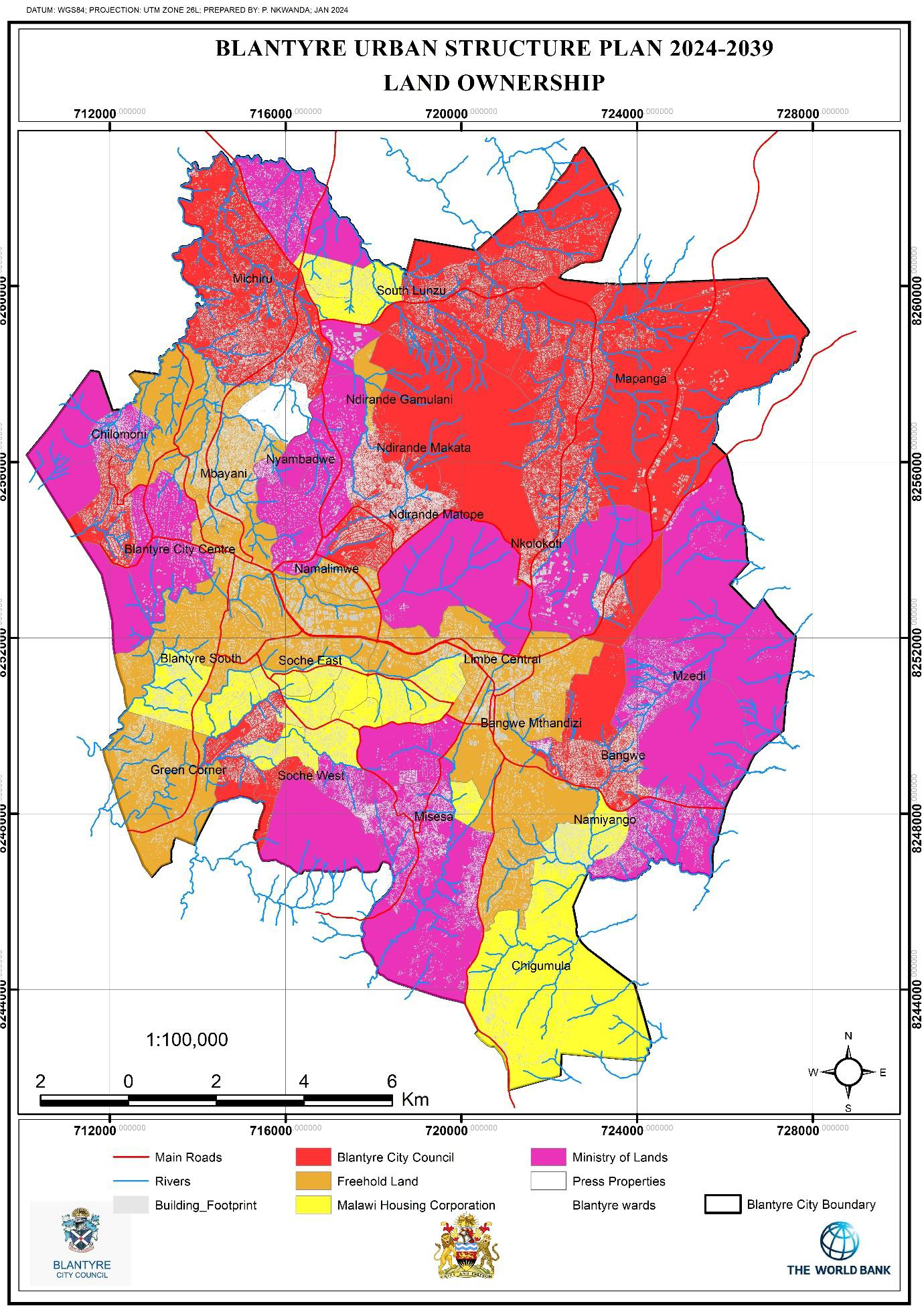
The Map shows that large portions of land is owned by the Malawi Government and administered by the Ministry of Lands. The Malawi Housing Corporation also owns substantial land areas. The Ministry of Lands, upon application from individuals or families, allocated land portions in the land areas under its ownership. This resulted in a gradual organic type of densification of land on the urban fringe inside the boundary. In some cases, these concentrations became so dense that it is now called unplanned settlement or dense rural type settlement. As a result, all the land left within the Blantyre boundary have some kind of settlement already; in some cases, dense and in others medium or low rural-type densities. Both the Ministry of Lands and Malawi Housing Corporation initiate the development of new townships while the Ministry of Lands also allocate land under leasehold to individuals. It is further alleged that so called “town chiefs’ also allocate land as if the land within the city boundary is customary land.